
Vaping
Cohiba Cuban Cigars vs Other Cuban Brands: Key Differences Explained


Cuban cigars have a long-standing reputation for tobacco craftsmanship, distinctive flavour profiles, and traditional production methods. Among the best-known names, Cohiba stands out for its history, specialised tobacco blends, and premium market positioning. However, other Cuban brands, including Montecristo, Romeo y Julieta, Partagás, and Hoyo de Monterrey, have their own identities and characteristics.
Understanding the differences between Cohiba and other Cuban cigar brands requires looking at their history, tobacco blends, sizes, flavour descriptions, and product ranges. Each brand offers a different approach to cigar production, making direct comparisons more complicated than simply comparing prices or reputations.
The History of Cohiba and Other Cuban Brands
Cohiba was established in Cuba in 1966. Initially, its cigars were produced for Cuban government officials and diplomatic gifts before becoming available internationally in 1982. The brand is closely associated with the El Laguito factory in Havana and has developed a reputation for premium Cuban cigar craftsmanship.
Montecristo, by comparison, was established in 1935 and became widely recognised for its extensive range of traditional cigar formats. Romeo y Julieta dates back to 1875, while Partagás was founded in 1845. Hoyo de Monterrey was established in 1865.
These brands have different histories and production traditions. Cohiba is often associated with exclusivity and specialised collections, while other Cuban brands have developed broad product ranges serving different preferences and market segments.

Tobacco Blends and Craftsmanship
One of the defining features of Cohiba is its approach to tobacco selection and fermentation. Traditional Cohiba production includes additional fermentation of certain filler leaves, particularly seco and ligero. This process contributes to the characteristics associated with its blends.
The Cohiba Behike collection is especially notable for incorporating medio tiempo tobacco leaves, which develop near the tops of certain tobacco plants and are not produced by every plant.
Other Cuban brands also rely on carefully selected tobacco and skilled cigar-making techniques. Partagás is often associated with robust, earthy profiles, while Montecristo offers a broad range of blends and formats. Romeo y Julieta and Hoyo de Monterrey also have distinctive product identities.
However, flavour descriptions are subjective. A particular cigar’s character depends on its specific blend, tobacco origin, fermentation, construction, and storage conditions rather than its brand name alone.
Flavour Profiles: How Do the Brands Compare?
Cohiba cigars are commonly described with notes such as cedar, earth, roasted coffee, spice, and subtle sweetness. The exact profile varies between collections, including Línea Clásica, Maduro 5, and Behike.
Montecristo cigars are often associated with balanced, earthy, woody, and occasionally spicy characteristics. Partagás products are frequently described as fuller-bodied, with earthy and peppery notes. Romeo y Julieta offers a varied range, with some products described as woody, creamy, or lightly spicy. Hoyo de Monterrey is often associated with more delicate and balanced flavour descriptions.
These are general descriptions, not fixed rules. Individual products within each brand can differ considerably, and personal perceptions of flavour naturally vary.
Sizes and Cigar Formats
Cohiba offers multiple formats, including Robusto, Corona-related sizes, longer cigars, and specialised Behike formats. The original Behike collection includes the BHK 52, BHK 54, and BHK 56, with different lengths and ring gauges.
Montecristo, Romeo y Julieta, Partagás, and Hoyo de Monterrey also offer cigars in a variety of sizes. Robusto formats are generally shorter and thicker, while Churchill formats are longer. Corona formats usually have a slimmer profile, although exact dimensions depend on the specific product.
Size influences a cigar’s proportions and potential smoking duration, but it does not determine quality or flavour by itself. Tobacco blend and construction remain important considerations.
Price and Market Positioning
Cohiba is generally positioned at the premium end of the Cuban cigar market. Special releases such as Behike and the Cohiba 55 Aniversario are associated with distinctive packaging, limited availability, and high prices in many markets.
Other Cuban brands offer a wider range of products at different price points. Montecristo, Romeo y Julieta, Partagás, and Hoyo de Monterrey each have established premium offerings, but their prices vary according to format, release, availability, and retailer.
A higher price does not automatically mean a cigar will offer a better personal experience. Buyers should compare the exact product, verify authenticity, and consider reliable product information rather than relying exclusively on brand reputation.
Packaging and Authenticity
Cohiba’s distinctive yellow-and-black branding makes the brand recognisable, but counterfeit products can imitate its appearance. Packaging alone is not sufficient proof of authenticity.
When comparing Cuban cigars, examine the original box, relevant security seals, and product information. For Cuban Habanos products, the official Habanos website provides guidance on authentication features. Purchasing from reputable authorised retailers can reduce the risk of encountering counterfeit products.
This is particularly important for expensive or limited-edition cigars, where convincing packaging can make counterfeit products difficult to identify through photographs alone.
Which Cuban Cigar Brand Stands Out?
There is no single answer because each brand has its own strengths and product characteristics. Cohiba is notable for its history, premium positioning, and specialised tobacco blends. Montecristo offers a broad range of familiar formats, while Partagás has a strong identity associated with fuller-bodied cigars. Romeo y Julieta and Hoyo de Monterrey also provide distinctive collections with varied characteristics.
The most useful comparison is between specific cigars rather than entire brands. Dimensions, tobacco blend, construction, authenticity, and storage condition provide more meaningful information than reputation alone.
Final Thoughts
Cohiba differs from other Cuban cigar brands through its history, specialised blends, distinctive collections, and premium market position. Montecristo, Romeo y Julieta, Partagás, and Hoyo de Monterrey have their own histories, formats, and flavour characteristics, making each brand distinct.
For reliable product information, consult the official Habanos website and verify the exact cigar rather than assuming every product within a brand is identical.
Cigars contain tobacco and expose users to nicotine and harmful chemicals. Smoking carries serious health risks, including cancer and cardiovascular disease, regardless of brand, price, format, or craftsmanship.
Author

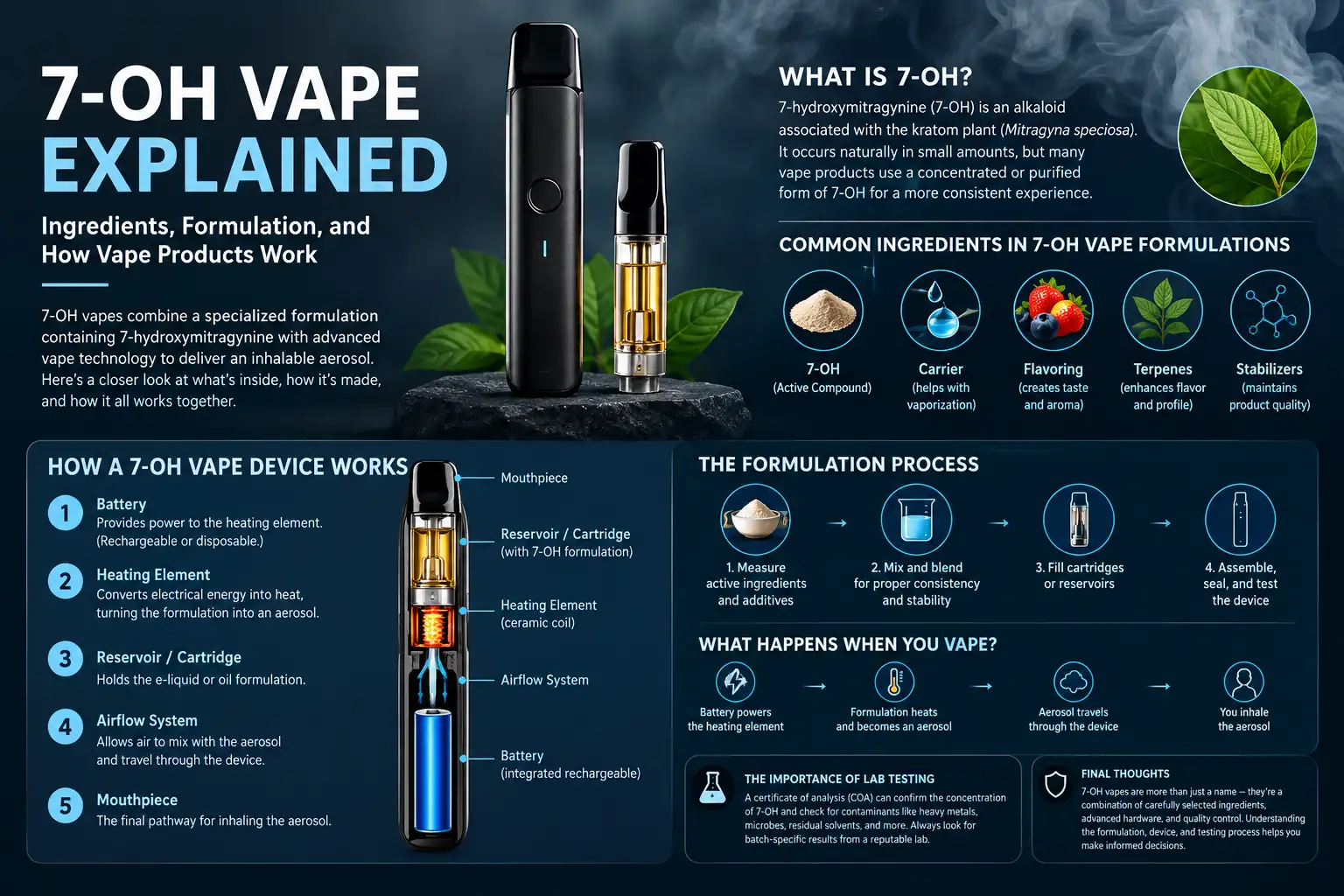
7-OH Vape Product
A 7-OH vape product brings together two distinct elements: a chemical formulation and an electronic delivery device. The formulation contains the substances identified by the manufacturer, while the hardware provides the components required to store and heat the liquid.
Because products can differ considerably in design and labeling, understanding how these elements fit together provides a more useful picture than relying on a product name alone. Specifications such as liquid volume, ingredient information, batch identification, heating hardware, and laboratory documentation can all provide additional context.
Starting With the Product Label
The label is usually the first source of information available to someone examining a packaged vape product. Depending on the manufacturer, it may include the product name, stated ingredients, liquid volume, batch or lot number, manufacturing information, and other specifications.
A label can also indicate how much of a particular compound the manufacturer reports in the product. However, the number should always be considered alongside its unit and measurement basis.
For example, an amount stated for an entire device is different from a concentration expressed relative to a particular volume. Treating these measurements as identical can create an inaccurate comparison between products.
The label therefore provides a starting point rather than a complete assessment of the formulation.
Understanding the Liquid Component
The liquid inside a vape device can contain several different types of ingredients. A product identified as containing 7oh disposable vape may list 7-hydroxymitragynine as one of its principal components.
Additional ingredients can vary according to the formulation. These may include carrier materials, flavoring substances, or other compounds listed by the manufacturer.
The exact composition matters because different ingredients can behave differently during storage and heating. An ingredient being commonly used in another type of product does not automatically establish that it is appropriate for inhalation.
For that reason, ingredient lists should be examined carefully, particularly when a product contains a specialized or concentrated compound.
Liquid Capacity and Product Size
Another important specification is the amount of liquid contained in the device.
Capacity may be expressed in milliliters or another appropriate unit and describes the physical amount of formulation the reservoir is designed to hold. It does not, by itself, indicate how much 7-OH is present.
Two products can have the same liquid capacity while reporting different concentrations. Conversely, two products can report similar amounts of a compound while using different liquid volumes.
This distinction is particularly useful when comparing product specifications because size, volume, and concentration describe different characteristics.
Examining the Device Structure
The hardware surrounding the formulation consists of several components.
A battery supplies electrical power. The heating element converts that electrical energy into heat. A reservoir, cartridge, or pod stores the formulation, while an airflow path directs air through the device. The mouthpiece provides the outlet.
The way these components are arranged depends on the product design.
Disposable devices generally integrate the main components into one housing. Cartridge systems separate the formulation-containing component from the battery, while refillable devices use tanks or pods that are designed to hold additional liquid.
These different configurations affect the physical construction of the product but do not independently establish the characteristics of the formulation.
Heating Systems and Airflow
The heating system is one of the most important pieces of vape hardware. Its purpose is to transfer heat to the formulation so that an aerosol can be produced.
Different devices can use different heating elements and internal arrangements. Airflow systems can also vary, with manufacturers designing different paths for air to move through the device.
From a 7oh disposable vape specification perspective, these features help explain why two devices containing similar types of formulations can have very different physical designs.
However, hardware specifications should not be confused with evidence of formulation safety. The presence of a particular heating element does not establish that every ingredient remains unchanged or suitable for inhalation when heated.
Disposable, Rechargeable, and Cartridge Formats
Vape products are available in several physical formats.
A standard disposable generally contains a pre-filled reservoir and an integrated battery. The components are enclosed within a single device.
A rechargeable disposable has a similar integrated construction but includes a rechargeable power source.
Cartridge-based products use a separate battery and cartridge arrangement. The cartridge may contain the formulation and heating component, while the battery provides power.
Refillable systems are designed around reusable hardware and a tank or pod that can be filled with a compatible formulation.
These formats differ mainly in construction, maintenance, and component replacement. The device category itself does not establish the contents of the liquid.
The Importance of Batch Numbers
Batch and lot numbers provide a connection between a physical product and its production records.
A manufacturer may use a batch number to identify when a product was produced, which formulation was used, and which quality-control records apply to that production run.
Batch identification becomes particularly useful when laboratory testing is available. A test report that contains a matching batch or sample identifier provides stronger product-specific context than a generic laboratory document that does not identify the relevant production run.
Other information, such as manufacturing dates and recommended storage conditions, can also help establish the history of a product.
What a Certificate of Analysis Can Show
A certificate of analysis, or COA, provides analytical results from a tested sample. The information included depends on the laboratory and the tests requested.
A report may identify the sample, testing date, analytical methods, and measured levels of specific compounds. Some reports may also include additional screening results.
When examining a COA, it is useful to check whether the product name, sample identification, batch number, and testing information correspond to the product being evaluated.
A laboratory report also has boundaries. Testing for a particular compound does not automatically confirm the identity of every ingredient or establish that a finished vape formulation is safe for inhalation.
Storage and Product Stability
Storage conditions can influence both the liquid formulation and the hardware.
Temperature, light, humidity, and exposure to air can affect certain formulations over time. Packaging and seals are intended to provide protection against environmental exposure, but damaged packaging can reduce that protection.
Electronic components can also be affected by prolonged storage. Batteries, seals, connections, and heating components may deteriorate depending on storage conditions and product age.
This is why manufacturing dates, storage instructions, and recommended shelf-life information can be useful when reviewing an older product.
Separating Specifications From Marketing Language
A useful way to evaluate product information is to separate measurable specifications from promotional descriptions.
Liquid capacity, ingredient declarations, batch numbers, device dimensions, battery specifications, and laboratory results are examples of information that can potentially be documented.
Claims about effects, performance, purity, or safety require appropriate supporting evidence. A product’s packaging or branding should not be treated as independent proof of such claims.
This distinction becomes especially important when comparing products from different manufacturers or suppliers.
Final Thoughts
A 7-OH vape product is more than a liquid contained inside an electronic device. Its overall specification includes the formulation, liquid volume, container, heating system, battery, airflow design, packaging, labeling, and available testing documentation.
Looking at these elements individually creates a clearer understanding of how products differ. Product labels can provide basic information, batch numbers can connect products to production records, and laboratory reports can provide analytical results for tested samples.
At the same time, specifications should remain separate from assumptions about safety or effects. The health risks associated with inhaling 7-OH formulations are not sufficiently established, so product descriptions and hardware features should not be interpreted as proof that a particular formulation is safe for inhalation.
Author


A strong digital presence helps businesses present their products, services, and brand information in a clear and professional way. For Vape Businesses, a well-structured website can make it easier for visitors to find useful information and understand what the business offers. A vape SEO agency Dubai can support this process through keyword research, technical SEO, website optimization, content planning, and performance tracking.
However, digital marketing must also follow relevant UAE regulations, advertising rules, age restrictions, and platform policies. Businesses should focus on creating a website that offers clear information, simple navigation, and a consistent experience across different devices.
Developing a Search-Focused SEO Strategy
Search engine optimization involves several activities that work together to improve organic visibility. Keyword research provides an important starting point. It helps businesses discover relevant search terms and understand the topics that potential customers explore online.
Technical SEO also plays an important role. It helps search engines crawl, interpret, and index website pages correctly. Meanwhile, on-page optimization, internal linking, useful content, and website performance can strengthen the overall SEO foundation.
For Vape Businesses, quality should always come before keyword repetition. Content should answer genuine questions and match the search intent behind each query. Businesses should avoid keyword stuffing, misleading statements, and unsupported claims. Instead, they should publish clear and useful information that readers can understand easily.
Using AI to Support SEO
An AI SEO company for vape shop businesses can use artificial intelligence to make several SEO tasks more efficient. AI tools can assist with keyword research, content analysis, competitor research, data processing, reporting, and identifying patterns within large datasets.
Still, AI should support SEO professionals rather than replace them. Automated tools can produce useful insights, but they may also miss context or create inaccurate information. Therefore, human specialists should review AI-assisted content before publication.
A professional review can check factual accuracy, originality, readability, search intent, and compliance. This extra step helps businesses maintain a reliable and professional online presence.
Combining AI With Human Expertise
AI can handle repetitive tasks quickly. However, effective SEO still requires human judgment. SEO professionals can determine whether a page actually answers a visitor’s question and whether keywords appear naturally within the content.
They can also review technical recommendations and respond to changes in search behavior. As search trends evolve, businesses may need to adjust their content and optimization strategies.
By combining automation with human expertise, Vape Businesses can improve workflow efficiency without sacrificing content quality. Human oversight also becomes important when website information needs regular updates or must meet specific regulatory and platform requirements.
Creating Effective Vaping SEO Campaigns
Vaping SEO Services may include keyword research, technical audits, on-page optimization, content creation, internal linking, competitor analysis, website improvements, and performance reporting.
The right combination depends on the website, target market, competition, and business goals. Before launching a campaign, businesses should also consider advertising restrictions, age-related requirements, and the policies of search engines and other digital platforms.
A structured SEO campaign can improve organic visibility while keeping the website informative and easy to navigate. It should also focus on sustainable improvements instead of short-term tactics that could damage the website’s reputation.
Optimizing Product and Category Pages
Product and category pages form an important part of e-commerce websites. Each page should include accurate information, clear headings, useful descriptions, and relevant specifications where appropriate.
Category pages can cover broader topics, while individual product pages can provide more detailed information. Internal links can then connect related categories, products, and educational resources.
Regular website reviews can also uncover duplicate descriptions, broken links, outdated information, and other content problems. Fixing these issues can improve navigation and help search engines understand the site’s structure.

Improving Local Search Visibility
Local SEO can help businesses appear for searches related to specific geographical areas. A local SEO vape shop New Zealand strategy may include location-based keyword research, accurate business information, relevant landing pages, local references, and website optimization.
However, businesses should avoid creating multiple pages that simply replace one city or region name with another. Each location page should offer genuinely useful information for its intended audience.
Businesses targeting the New Zealand market should also consider applicable local laws, advertising requirements, and platform policies before implementing location-focused marketing strategies.
Creating Useful Location-Specific Content
Location-specific content should provide real value to people in the selected market. For example, pages can explain relevant business information, service areas, contact details, delivery information where applicable, and other useful local details.
When Vape Businesses target multiple countries, they should avoid publishing identical pages for every market. Instead, they should adapt content to each audience and location. This approach creates a more useful website and gives search engines clearer geographical context.
Strengthening Technical SEO
Technical SEO creates the foundation for a search-friendly website. Important areas include page speed, mobile usability, indexing, redirects, XML sitemaps, structured data, canonical tags, and broken links.
E-commerce websites may face additional challenges because they often contain many URLs. Poor URL management can create crawling and indexing problems. Regular technical audits can identify these issues before they affect website performance.
A technically sound website can also provide a smoother experience for visitors. This matters because people may access websites through smartphones, tablets, laptops, or desktop computers.
Measuring SEO Performance
Businesses should measure SEO performance through several indicators rather than relying only on keyword rankings. Organic traffic, impressions, clicks, keyword visibility, engagement, technical performance, and relevant conversions can all provide useful insights.
Regular reports show which pages attract visibility and which areas need further improvement. The data can then guide decisions about new content, technical updates, internal linking, and location-focused pages.
Consistent measurement also helps Vape Businesses understand whether their SEO efforts support broader digital marketing goals. Over time, this information can help teams refine their strategies and focus resources on areas that need attention.
Keeping Website Information Accurate
Accurate information helps build trust with website visitors. Businesses should regularly check product specifications, compatibility information, dimensions, available options, service details, and other important information against reliable sources. They should also update pages whenever products, services, policies, or business details change. Content audits can identify outdated pages, broken links, and information that no longer provides value. A current and well-maintained website creates a more professional experience. It also helps visitors find the information they need without unnecessary confusion.
Final Thoughts
Building a strong online presence requires more than adding keywords to a website. Businesses need a clear SEO strategy, useful content, reliable information, and a technically sound website. At the same time, they must consider local regulations and digital platform requirements.
AI can make SEO work faster and more efficient, but human expertise remains essential. Professional review ensures that content stays accurate, natural, useful, and relevant to the target audience. Likewise, regular website audits and performance tracking help identify problems before they affect visibility.
Ultimately, consistent optimization creates a stronger foundation for long-term organic growth. By combining quality content, technical improvements, local SEO, AI-assisted tools, and human expertise, businesses can build a professional digital presence that serves both search engines and website visitors.
Author


Achieving stronger search visibility can help businesses build a reliable digital presence in the New Zealand market. However, effective search engine optimization requires more than simply adding keywords to a website. It involves creating useful content, improving technical performance, understanding search intent, and offering visitors a smooth browsing experience.
For Vape Stores, a well-planned SEO strategy can improve organic visibility and help potential customers find relevant business information more easily. The right approach should combine keyword research, technical optimization, quality content, local relevance, and regular performance reviews.
Understanding Google Ranking in New Zealand
Google considers many signals when deciding how to rank webpages. These signals include content relevance, website quality, technical performance, mobile usability, authority, and overall user experience.
Businesses should therefore build websites that visitors can understand and navigate without difficulty. Clear menus, logical categories, readable content, and accurate business information all contribute to a better experience.
Keyword research also plays an important role. Businesses can identify phrases that people use when searching for relevant information in New Zealand. They can then use those terms naturally in page titles, headings, descriptions, category pages, and helpful articles.
However, keyword stuffing can make content difficult to read. Instead, writers should focus on search intent and provide information that genuinely answers users’ questions.
Creating a Strong SEO Foundation
Technical SEO creates the foundation for long-term organic performance. Search engines need to crawl and understand a website efficiently. Therefore, businesses should regularly review important technical elements such as page speed, mobile responsiveness, internal links, XML sitemaps, redirects, canonical tags, structured data, and broken links.
E-commerce websites often require additional attention because they may contain hundreds of product and category URLs. Without proper management, duplicate pages, outdated URLs, and indexing problems can affect search visibility.
Regular SEO audits can uncover these issues before they become larger problems. They can also reveal missing metadata, weak internal linking, slow pages, and sections that search engines struggle to index.
A simple website structure also benefits visitors. Users should be able to move naturally between category pages, product information, educational resources, and contact details. When navigation feels straightforward, visitors can find information faster and spend more time exploring relevant pages.
Using AI to Support SEO
An AI SEO company for Vape Stores, businesses can use artificial intelligence to make certain SEO tasks more efficient. For example, AI tools can assist with keyword research, competitor analysis, content planning, data analysis, and reporting.
Still, AI should support experienced professionals rather than replace them. Human specialists need to review AI-generated ideas and content before publication. They should check every piece for accuracy, originality, readability, relevance, and compliance with applicable requirements.
This human review becomes especially important when a website contains business, product, or regulatory information. Such details can change over time, so businesses need to keep their content accurate and current.
When professionals combine AI-assisted research with practical SEO knowledge, they can identify opportunities faster while maintaining editorial quality. This approach can also help content teams spend more time on strategy, creative development, and audience needs.
E-commerce SEO for the New Zealand Market
An effective e-commerce SEO strategy should give every important page a clear purpose. Product pages should contain accurate descriptions, useful specifications, clear headings, and relevant information. Category pages should also explain what visitors can find within each section.
Internal linking can further improve navigation. For example, businesses can connect related categories with relevant informational resources. This approach helps visitors discover useful pages while giving search engines clearer signals about the website structure.
Businesses should also review their pages regularly. They can remove outdated information, fix broken links, improve missing metadata, and address duplicate descriptions. These small improvements can contribute to a cleaner and more useful website.
Mobile optimization deserves equal attention. Many people browse websites from smartphones, so pages should load quickly and remain easy to use on smaller screens. A responsive design can make navigation simpler and create a consistent experience across different devices.

Developing Location-Focused Content
Local relevance can strengthen an SEO strategy for businesses serving customers across New Zealand. Website content can include genuine information about service areas, business operations, delivery details where appropriate, customer support, and contact information.
However, businesses should avoid producing dozens of nearly identical location pages. Changing only a city or region name does not create useful local content. Searchers expect pages to provide information that relates to their actual needs.
Instead, every location-focused page should offer details that genuinely relate to its intended audience. This approach creates more value for visitors and gives search engines a clearer understanding of the business’s local relevance.
For Vape Stores, local optimization should remain natural and informative. Businesses should focus on providing accurate information rather than trying to manipulate search results through repetitive location keywords. Genuine local information can also help establish greater trust with visitors.
Working With an SEO Marketing Agency
An SEO Marketing Vaping Agency can provide professional support across several areas of search optimization. Services may include keyword research, technical audits, on-page optimization, competitor analysis, content planning, internal linking, local SEO, and performance reporting.
The right strategy will vary from one business to another. Competition, website history, target audience, content quality, and business objectives can all influence the approach.
SEO also requires patience. Search visibility can change as competitors publish new content, search behavior evolves, and search engine systems continue to develop. Regular monitoring helps businesses respond to these changes instead of relying on a one-time optimization campaign.
A professional SEO team can also identify content gaps and technical weaknesses that business owners may overlook. By reviewing performance data and making informed adjustments, businesses can gradually improve their website and strengthen their overall online presence.
Measuring SEO Performance
Businesses should measure more than keyword positions when evaluating SEO results. Organic impressions, clicks, website traffic, indexed pages, engagement, relevant enquiries, and conversions can provide a broader picture of performance.
Google Search Console and analytics platforms can help businesses understand how visitors discover and interact with their websites. Reviewing this information regularly can highlight successful pages and reveal areas that need improvement.
For Vape Stores, the main objective should not simply involve reaching the first position for one keyword. Instead, the goal should involve attracting relevant visitors and giving them useful, trustworthy information.
Performance data can also guide future content decisions. If a page receives impressions but few clicks, its title and description may need improvement. If visitors leave quickly, the page may need clearer information, better navigation, or a stronger connection to search intent.
Conclusion
Improving organic visibility requires a balanced approach. Businesses need strong technical foundations, useful content, relevant keywords, local information, mobile-friendly pages, and consistent performance monitoring.
For Vape Stores, SEO should focus on helping users find clear and relevant information rather than relying on excessive keyword repetition. AI can make research and analysis more efficient, while human expertise can maintain quality, accuracy, and originality.
A thoughtful SEO strategy takes time, but consistent improvements can create a stronger foundation for sustainable search visibility in the New Zealand market. By combining technical improvements with useful content and ongoing analysis, businesses can create a website that serves both search engines and real visitors more effectively.
Author


Millwork Drafting: Essential Details for Millwork Shop Drawings

How to Style Lost Hills Hoodies

How to Inspect Anchor Bolts in Service: A Practical Checklist

Cohiba Cuban Cigars vs Other Cuban Brands: Key Differences Explained

Your Trusted Exhibition Stand Builder in Germany and Europe

Best Comme des Garcons PLAY T-Shirts to Buy in the UK

What Are As-Built Drawings and Why Are They Important?

Kripaa Glamour: Elegant Jewellery & Timeless Style

Bearbricks: The Creative Collectibles Transforming Modern Pop Culture

How to Choose the Right Landscape Rendering Services for Commercial

Cybersecurity Consulting Company SequelNet Provides Critical IT Support Services to Medical Billing Firm, Medical Optimum

Meet the Megalodon: The Shark Star of ‘Meg 2’

Reduce Video Game Lag: Level Up Your Gaming Performance

Balancing India’s Entertainment: Cricket vs. Bollywood

Jetsetter’s Secrets: Unveiling Our Favorite Travel Hacks for a Seamless Adventure

The 5 Best Live Sports Streaming Sites: Legal and Exciting!

Hollywood Labor Unrest: The Impact of ‘What About Us?’ Strikes

Unveiling the Magic of Dream Fulfillment at the Late NBA Draft

Illuminate Your Skin: Dr. Axe Unveils Natural Remedies for Lightening Knees and Elbows

Bright Choices: Navigating the Pros and Cons of Skin Whitening Creams with Dr. Axe
-

 Business3 years ago
Cybersecurity Consulting Company SequelNet Provides Critical IT Support Services to Medical Billing Firm, Medical Optimum
-
Entertainment3 years ago
Meet the Megalodon: The Shark Star of ‘Meg 2’
-
Entertainment3 years ago
Reduce Video Game Lag: Level Up Your Gaming Performance
-
 Sports3 years ago
Balancing India’s Entertainment: Cricket vs. Bollywood
-
Entertainment3 years ago
Jetsetter’s Secrets: Unveiling Our Favorite Travel Hacks for a Seamless Adventure
-
Productivity3 years ago
The 5 Best Live Sports Streaming Sites: Legal and Exciting!
-
Art /Entertainment3 years ago
Hollywood Labor Unrest: The Impact of ‘What About Us?’ Strikes
-
Sports3 years ago
Unveiling the Magic of Dream Fulfillment at the Late NBA Draft






