
Business
VAT Consultancy Services in Dubai: Ensuring Compliance

By

Reviewed
By Olivia Jade

Navigating the complexities of Value Added Tax (VAT) in the UAE can be overwhelming, especially for small to mid-sized businesses. That’s where expert VAT consultancy services in Dubai come in — offering reliable guidance, ensuring compliance with Federal Tax Authority (FTA) regulations, and optimizing your VAT-related operations.
1. Why VAT Consultancy is Essential for Businesses in Dubai
Since the introduction of VAT in the UAE in 2018, every registered business must comply with its requirements. VAT consultants ensure:
-
Proper VAT registration
-
Accurate filing of VAT returns
-
Correct documentation of input and output VAT
-
Avoidance of penalties from non-compliance
-
Efficient VAT planning for cash flow management
2. Core Services Offered by VAT Consultants
Professional VAT consultancy services in Dubai typically include:
-
VAT Registration & Deregistration
-
VAT Return Filing & Record Keeping
-
VAT Health Check & Compliance Audits
-
VAT Impact Assessment
-
Input Tax Recovery Planning
-
Tax Dispute Resolution & FTA Representation
3. Who Needs VAT Consultants in Dubai?
-
Startups & SMEs unsure about thresholds and VAT applicability
-
E-commerce businesses dealing with cross-border supplies
-
Manufacturers and importers with complex VAT inputs and outputs
-
Free zone entities operating with mainland customers
-
Large corporations seeking internal audit and strategic tax planning
4. Advantages of Hiring a VAT Consultancy
-
Expertise in UAE Tax Law: Stay up-to-date with the latest FTA regulations.
-
Error-Free Filing: Reduce the risk of audits and fines.
-
Time & Cost Efficiency: Focus on core business functions while consultants manage VAT.
-
Tailored Tax Solutions: Align VAT structure with business goals.
5. Common VAT Challenges Businesses Face
-
Incorrect treatment of exempt and zero-rated supplies
-
Incomplete or improper invoice formats
-
Lack of supporting documentation
-
Late or missed VAT return filings
-
Misunderstanding FTA rules during audits
Professional consultants resolve these pain points with precision and speed.
6. Top VAT Consultancy Firms in Dubai
-
Nadeem and Umendra Chartered Accountants – Highly experienced in VAT compliance and FTA representation.
-
Emirates Chartered Accountants Group – Offers industry-specific VAT planning.
-
KGRN VAT Consultancy – Known for quick VAT registrations and accurate filing.
-
Push Digits Chartered Accountants – Technology-driven VAT solutions.
-
Creative Zone Tax & Accounting – Ideal for SMEs and new startups.
7. FTA Audits and VAT Penalties: Avoid Costly Mistakes
The FTA actively audits businesses and imposes penalties for:

-
Late registration or filing
-
Inaccurate returns
-
Improper invoice practices
-
Failure to maintain records for 5 years
Consultants ensure you’re audit-ready and penalty-proof.
8. How Much Do VAT Consultancy Services Cost in Dubai?
-
VAT Registration: AED 300 – AED 1,000
-
Monthly VAT Filing: AED 400 – AED 1,500/month
-
VAT Compliance Audit: AED 2,000 – AED 10,000 (depending on business size)
-
FTA Representation: Fees vary based on complexity
Many firms offer retainer packages for ongoing support.
Choosing the Right VAT Consultancy Service in Dubai
Picking a reliable consultancy ensures smooth VAT management. Consider these factors:
- Experience and Credentials
Look for firms with certified tax advisors and a strong track record in VAT compliance. Check client testimonials and case studies. - Range of Services
A full-service provider handles registration, filing, audits, and training. Avoid consultants who only offer limited help. - Industry Expertise
Some businesses—like hospitality or e-commerce—face special VAT rules. Choose consultants who know your sector’s challenges. - Transparent Fees
Reputable firms offer clear pricing—whether fixed fees per service or monthly retainers. Steer clear of hidden charges. - Local Presence
A Dubai-based office means quick in-person meetings and a deep understanding of local regulations.
Benefits of Professional VAT Consultancy
Engaging VAT consultants brings multiple benefits:
- Cost Savings: Avoid fines and optimize VAT recovery on purchases.
- Time Efficiency: Free up your staff to focus on core business tasks.
- Risk Reduction: Minimize errors and stay ahead of regulatory changes.
- Peace of Mind: Know experts handle your VAT affairs and can support you during audits.
- Strategic Advice: Consultants can advise on VAT impact for new projects, mergers, or cross-border transactions.
Common Challenges and How Consultants Help
Challenge 1: Complex Transactions
Cross-border sales, free zones, and mixed supplies can complicate VAT. Consultants map each transaction to the right VAT treatment, ensuring accuracy.
Challenge 2: Frequent Regulatory Updates
FTA issues new guides and clarifications regularly. Consultants subscribe to updates and adjust your processes accordingly.
Challenge 3: Cash Flow Management
VAT must be paid even if customers have not settled invoices. Advisors help you plan cash flow to meet VAT liabilities without straining working capital.
Challenge 4: Limited In-House Expertise
Small teams may lack VAT specialists. Consultants train your staff and act as an external department, reducing the learning curve.
Case Study: How Consultancy Improved Compliance
Consider a Dubai-based retailer facing erratic VAT filings. Late returns led to penalties of AED 20,000 in one year. After hiring a VAT consultancy service, the retailer saw:
- 0 Penalties for timely, accurate filings.
- AED 15,000 Extra Recovery through missed input tax claims.
- 1 Week Saved per month in staff time.
This realignment of resources boosted profitability and gave the owner confidence when expanding to online sales.
How to Prepare for Your First Consultant Meeting
- Gather Documents: Sales records, purchase invoices, bank statements, and FTA communications.
- List Challenges: Note issues you’ve faced—missed deadlines, system gaps, or unclear rules.
- Define Goals: Do you need only registration help, full-cycle support, or audit representation?
- Set a Budget: Have an idea of what you can spend monthly or per service.
- Ask Questions: Inquire about their process, response times, and references.
A well-prepared meeting leads to a clear roadmap for compliance and sets realistic timelines.
Conclusion
Ensuring VAT compliance in Dubai is crucial for every business. Expert VAT consultancy services Dubai guide you through registration, invoicing, return filing, and audits. They help you avoid penalties, recover rightful input tax, and manage cash flow wisely. When selecting VAT consultants, focus on experience, service range, industry knowledge, and transparent fees. Proper consultancy not only keeps you compliant but also frees your team to focus on growth. Ready to secure your VAT affairs? Engage a trusted consultancy today and ensure your business thrives in Dubai’s dynamic market.
Author


In our current information age, businesses rarely suffer from a lack of data. Instead, they struggle with a “data deluge”—a massive, unorganized flood of information that obscures clear paths forward. The real challenge is no longer finding information; it is the art of curating, validating, and interpreting that information to make high-stakes decisions.
Secondary Research Services act as the professional filter for this data. By systematically analyzing existing records, these services transform scattered facts into structured intelligence. This process allows organizations to understand market landscapes without the high costs and long timelines of original field studies.
1. What Are Secondary Research Services?
At its core, secondary research is the practice of analyzing information that has already been collected, recorded, and published by others. Unlike primary research—which involves fresh surveys or focus groups—secondary research looks at the wealth of knowledge already available in the public and private domains.
Professional services go far beyond a simple “Google search.” They apply a rigorous, scientific methodology to ensure the resulting insights are reliable enough to bet a business strategy on.
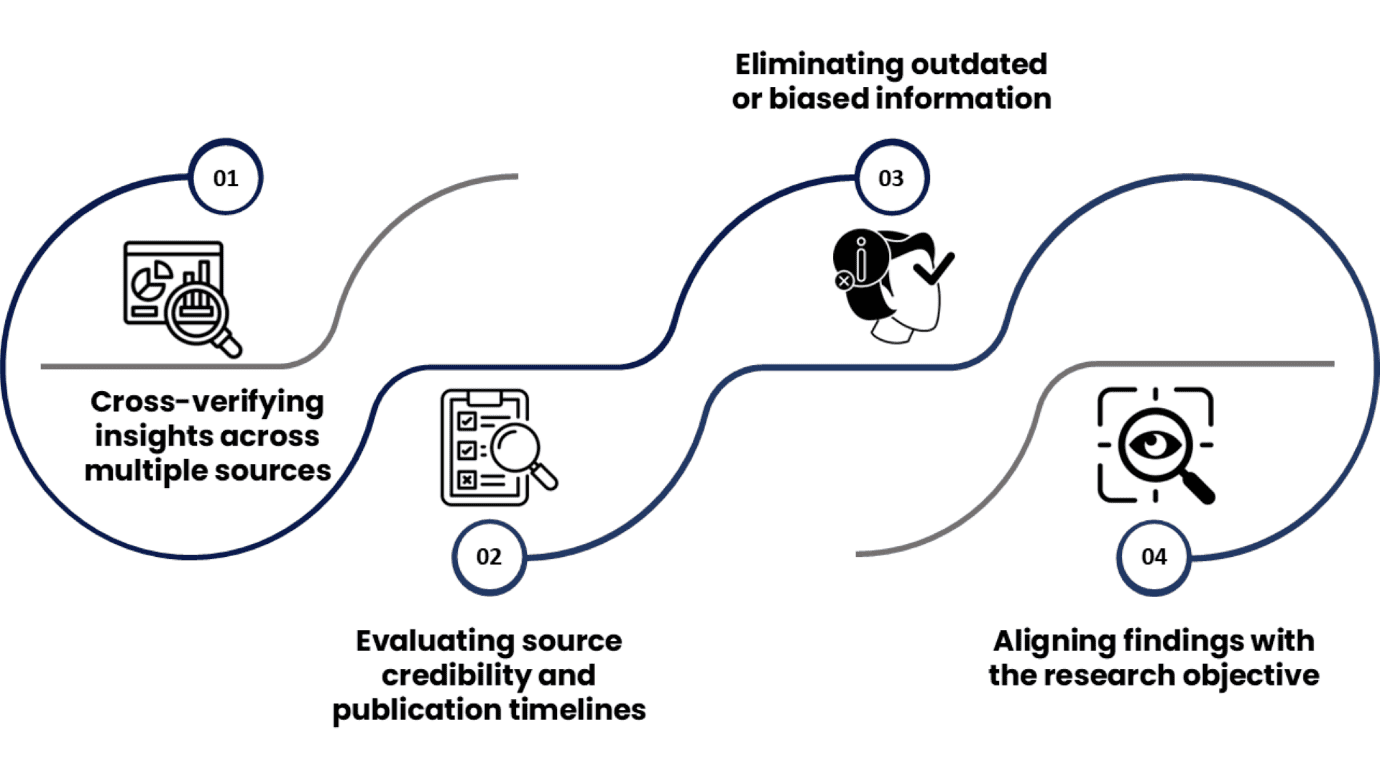
The Pillars of Professional Analysis:
-
Objective Definition: Scientists start by identifying the exact business question that needs answering.
-
Source Validation: Not all data is equal. Experts vet sources for credibility, bias, and timeliness.
-
Triangulation: This is the “gold standard” of research. By comparing three or more independent data sources, researchers can confirm a fact or identify a range of probability.
-
Synthesis: The final step involves connecting the dots to create a narrative that a CEO or Board of Directors can act upon immediately.

2. Strategic Use Cases: When Does it Make Sense?
Smart organizations use secondary research as their “first strike” in strategic planning. It provides the groundwork that informs every subsequent move.
Market Entry and Regional Expansion
Before a company spends millions to launch in a new country, they need to know the “lay of the land.” Secondary research identifies regional demand, regulatory hurdles, and growth trajectories. It tells you if the “water is warm” before you jump in.
Competitive Intelligence and Benchmarking
You cannot defeat a competitor you do not understand. Researchers dive into annual reports, investor presentations, and patent filings to build a 360-degree view of your rivals. They track hiring patterns to predict a competitor’s next product launch or analyze their pricing models to find your own competitive edge.
Market Sizing and Realistic Forecasting
Calculations like Total Addressable Market (TAM) or Serviceable Obtainable Market (SOM) are the backbone of any pitch deck or expansion plan. Secondary research pulls from trade statistics and independent datasets to build these models, providing a realistic view of the potential ROI.
Procurement and Risk Management
In an era of fragile supply chains, knowing your vendors is critical. Secondary research maps out the supplier landscape, checks for compliance issues, and flags potential geopolitical or operational risks before you sign a contract.
3. The Anatomy of a Reliable Data Ecosystem
Professional researchers draw from a diverse “well” of information to ensure accuracy. A single source is a guess; multiple sources are evidence.
-
Public Filings: Annual reports (10-Ks), ESG statements, and investor transcripts provide the most reliable “hard” data.
-
Governmental Archives: Trade statistics, census data, and regulatory filings offer a macro-view of the economy.
-
Trade Associations: Industry-specific journals and white papers provide deep-dive insights into niche sectors like biotechnology or renewable energy.
-
Independent Analyst Reports: Firms like Gartner or Forrester offer expert commentary that adds a layer of interpretation to the raw numbers.
4. Benefits and Strategic Advantages
Why do global leaders rely so heavily on secondary research? The answer lies in efficiency and perspective.
-
Speed to Insight: While a primary survey can take months, a deep-dive secondary analysis can often be completed in weeks, allowing for rapid pivoting.
-
Cost-Efficiency: You are leveraging work that has already been done, which is significantly more affordable than launching a massive global field study.
-
Broad Industry Perspective: Primary research is often narrow and deep; secondary research is broad and contextual. It allows you to see the “forest” rather than just the individual trees.
-
Foundational Groundwork: It identifies the gaps. By doing secondary research first, you ensure that if you do eventually perform primary research, you are asking the right questions.
5. Navigating the Limitations
No research method is perfect. To use secondary research effectively, you must understand its boundaries. It is often “historical”—it tells you what has happened up until yesterday.
Furthermore, it cannot tell you the “why” behind a specific consumer’s emotion or their exact willingness to pay for a brand-new innovation. For those hyper-specific insights, savvy businesses use secondary research to build the frame and primary research to paint the final picture.
6. Secondary vs. Primary: A Quick Comparison
| Feature | Secondary Research | Primary Research |
| Data Source | Existing records/publications | New, original data collection |
| Speed | High / Immediate | Moderate to Slow |
| Cost | Low to Moderate | High |
| Focus | Broad market trends | Specific, targeted behaviors |
| Best Used For | Market scanning & sizing | Product testing & deep psychology |
7. Why Professional Interpretation is the “X-Factor”
In 2026, the value is not in the data itself—it is in the validation. Anyone can find a statistic online, but only a professional researcher can tell you if that statistic is skewed by a specific interest group or if the methodology behind it was flawed.
Professional services provide triangulation and documentation. They don’t just give you a number; they give you a confidence interval and a list of verified sources. This rigor turns “information” into “intelligence” that can withstand the scrutiny of a boardroom.
Conclusion: From Information to Decisive Action
Secondary Research Services are the bedrock of modern strategic analysis. They provide the clarity needed to navigate complex markets, the evidence required to secure investments, and the foresight needed to outmaneuver the competition.
By transforming raw, unorganized data into a structured strategic narrative, these services empower leaders to move with confidence. Don’t let your next big decision be a shot in the dark. Use the power of existing knowledge to illuminate your path to success.
Ready to gain a clearer view of your market?
Transform the world’s data into your company’s competitive advantage. Connect with UnivDatos today. Whether you are exploring a new region or benchmarking a rival, we craft the research plan you need to win.
Author


In the high-velocity business landscape of 2026, simply launching a quality product is no longer a guarantee of success. Organizations now operate in an environment defined by rapid AI integration, shifting global trade dynamics, and hyper-informed consumers. To thrive, businesses must move beyond basic data and embrace Market Intelligence Services—the bridge between raw information and decisive action.
This guide explores how market intelligence serves as the “GPS” for your corporate strategy, ensuring your Go-To-Market (GTM) plans are grounded in reality rather than guesswork.
Understanding Market Intelligence: Beyond the Basics
At its core, Market Intelligence Services involve the systematic gathering and deep analysis of data related to your industry’s ecosystem. It is the process of transforming scattered data points into a coherent narrative.
By leveraging these services, businesses can:
-
Pinpoint High-Growth Opportunities: Find the “white space” in the market before your competitors do.
-
Map the Competitive Chessboard: Move beyond knowing who your rivals are to understanding their next move.
-
Decode Customer Intent: Align your product development with the actual evolving needs of your target audience.
-
Shield Against Volatility: Anticipate regulatory shifts and economic downturns to build a more resilient brand.
The Critical Shift: Market Research vs. Market Intelligence
Many professionals use these terms interchangeably, but in a strategic context, they represent two different stages of the decision-making funnel.
| Feature | Market Research Services | Market Intelligence Services |
| Primary Goal | Data Collection & Validation | Strategic Implementation |
| Output | Facts, Figures, and Trends | Actionable Strategies & GTM Blueprints |
| Time Horizon | Often focuses on current or past data | Predictive and forward-looking |
| Core Function | Answers: “What is happening?” | Answers: “What should we do about it?” |
The Takeaway: Market research provides the map; market intelligence provides the navigation strategy to reach your destination.


Navigating the Modern Market Map
Once your product is shelf-ready, the most daunting question is often: Where do we go first? This is where intelligence becomes your most valuable asset. At UnivDatos, we specialize in translating complex market signals into clear directives. We don’t just hand you a report; we help you see the market like a master strategist.
Turning Insights into GTM Momentum
A Go-to-Market (GTM) strategy is only as strong as the intelligence behind it. With a structured approach, you turn theoretical knowledge into a tactical strike. Our solutions at UnivDatos ensure that your GTM plan isn’t just a document—it’s a living strategy that adapts to real-world feedback.
Why Intelligence is Mandatory in 2026
In an era of “instant” competition, the cost of being wrong has never been higher. Without a dedicated intelligence stream, businesses frequently fall into these traps:
-
The Demand Gap: Building products for a market that has already moved on.
-
The Blindside: Being disrupted by a startup or technology you didn’t see coming.
-
Timing Errors: Entering a market too early (before demand exists) or too late (when it’s saturated).
-
Pricing Friction: Leaving money on the table or pricing yourself out of the conversation.
The Five Pillars of Effective Intelligence
To drive real growth, your intelligence services should focus on these five core components:
-
Market Sizing and Forecasting
Knowing the current value of a market is vital, but knowing its trajectory is essential. We use advanced predictive modeling to help you plan investments for the next 3 to 5 years.

-
Competitive Benchmarking
We look past the surface of your competitors. We analyze their pricing structures, supply chain advantages, and digital footprints to find the vulnerabilities you can exploit.
-
Customer and Demand Analysis
Demographics tell you who is buying; behavior analysis tells you why. By identifying unmet needs, you can refine your messaging to resonate on a deeper emotional level.
-
Channel and Distribution Strategy
Should you go Direct-to-Consumer (D2C), rely on a partnership model, or leverage digital marketplaces? We help you find the “path of least resistance” to your customer.
-
Risk Assessment and Mitigation
From shifting ESG (Environmental, Social, and Governance) regulations to technological disruption, we identify the hurdles before you hit them, allowing for proactive pivoting.
Who Benefits Most?
Strategic intelligence is a universal tool, but it is particularly transformative for:
-
Agile Startups: To ensure limited capital is spent on the highest-probability opportunities.
-
Scaling SMEs: To navigate the complexities of expanding into unfamiliar territories.
-
Global Enterprises: To maintain a competitive edge and prevent “incumbent’s blindness.”
-
Tech Innovators: To validate that their “disruptive” tech has a viable commercial home.
Conclusion: Moving from Uncertainty to Opportunity
Market Intelligence Services provide the clarity required to lead rather than follow. By blending rigorous research with tactical execution, your organization can optimize every move, reduce entry risks, and secure long-term market leadership.
Ready to sharpen your strategy?
Let’s transform your data into a competitive weapon. Contact UnivDatos today to schedule a consultation and see how our intelligence services can elevate your brand.
Frequently Asked Questions
1. How does market intelligence improve ROI?
By identifying high-potential segments and avoiding “dead-end” markets, you ensure every dollar spent on marketing and R&D is targeted toward growth.
2. Is this only for large companies?
Not at all. Startups often benefit the most from intelligence, as they have the least room for error when entering a competitive space.
3. Can I use market intelligence for existing products?
Yes. Intelligence is vital for product lifecycle management, helping you decide when to update, pivot, or retire a product based on current demand.
Author


As the global pharmaceutical industry enters a bold new era of innovation, the role of Formulation Development has moved from the background to center stage. We are no longer just making pills; we are designing sophisticated delivery vehicles for precision medicine. This process is the vital bridge that connects a raw laboratory discovery to a life-saving clinical product.
Today, modern pharmaceutical companies leverage advanced technologies like Novel Drug Delivery Systems (NDDS) and Microencapsulation. These systematic approaches optimize drug performance to meet the diverse needs of patients worldwide.
1. The Bridge Between API and Patient: Building the Foundation
The journey of every drug begins with the Active Pharmaceutical Ingredient (API). This is the “hero” molecule intended to fight a disease. However, most heroes need a vehicle to reach their destination. Many modern APIs suffer from poor water solubility or extreme instability. They simply cannot survive the journey through the human body on their own.
This is where formulation technology steps in. Scientists combine the API with specific Pharmaceutical Excipients to create dosage forms that are stable, absorbable, and easy for patients to take.
Common Formulation Pathways include:
-
Semisolid Formulations: These include gels, ointments, and creams. They provide targeted relief for topical conditions, ensuring the drug stays exactly where it is needed.
-
Liquid Dosage Forms: Oral solutions and suspensions are essential for pediatric care. They offer flexible dosing for children and help patients who struggle to swallow solid tablets.
-
Injectable Dosage Forms: These range from simple water-based injections to complex lyophilized powders. They are the primary choice for vaccines and high-stakes biologics.
-
Lyophilized Formulations: Freeze-drying is a marvel of modern science. It enhances the shelf life of unstable drugs, making it possible to transport life-saving medicine across the globe without degradation.
2. Overcoming the Barrier: Solubility and Bioavailability
The pharmaceutical world faces a silent crisis: over 40% of new chemical entities are practically insoluble in water. If a drug cannot dissolve, the body cannot absorb it. This makes Solubility Improvement and Bioavailability Enhancement the two most critical goals in modern formulation labs.
To solve this, researchers use several “heavy-lifting” technologies:
-
Nanoparticle Development: By shrinking the API particles to a nanoscale, scientists vastly increase the surface area. This allows the drug to dissolve much faster and enter the bloodstream with higher efficiency.
-
Solid Dispersion Technology: Here, the API is hidden within a polymer “matrix.” This prevents the drug from crystallizing and keeps it in a state that is ready for absorption.
-
Microencapsulation: This technique acts like a tiny time-release capsule. It controls exactly how fast the API is released, allowing for sustained or targeted delivery.
By carefully choosing surfactants and permeation enhancers, formulators can turn a “failed” lab molecule into a blockbuster clinical success.
3. The Revolution of Novel Drug Delivery Systems (NDDS)
In 2026, the focus has shifted toward Drug Delivery Systems (DDS) that act like GPS for medicine. Instead of a drug flooding the entire body, these systems deliver the payload directly to the affected cells.
Cutting-edge NDDS technologies include:
-
-
Liposomes and Nanoliposomes: These fatty bubbles are perfect for carrying sensitive RNA-based drugs or potent anticancer agents directly to tumors.
-
Biodegradable Polymer Microspheres: These are used for long-acting injectables. A patient might receive one injection that releases medicine steadily over several months.
-
Gastro-floating and Colonic Systems: These designs ensure the drug is released in a specific part of the digestive tract, which is vital for treating localized diseases like Crohn’s.
-
Smart Responsive Carriers: These are the pinnacle of “intelligent” medicine. These carriers only release their cargo when they sense a specific pH level, temperature, or enzyme.
-
4. Validation: The Science of Pharmaceutical Analysis
You cannot manage what you cannot measure. Throughout the development cycle, Pharmaceutical Analysis acts as the quality guardian. It provides the hard data required by regulatory bodies like the FDA.
Key Analytical Steps:
-
Physicochemical Testing: Scientists analyze the API’s melting point, particle size, and polymorphism to predict how it will behave in a real-world environment.
-
In Vitro Release Studies: Researchers use dissolution baths to simulate the human stomach or gut. This confirms if a “slow-release” pill actually releases slowly.
-
Stability Studies: Drugs are placed in “stress chambers” with high heat and humidity. This determines the true shelf life and ensures the medicine remains safe until the day it expires.
-
Bioequivalence (BE) Studies: These tests prove that a new formulation performs the same way in the body as the original version.
5. The Strategic Rise of CDMO Partners
The speed of modern medicine is breathtaking. To keep up, many pharmaceutical giants now partner with Contract Development and Manufacturing Organizations (CDMOs). These partners provide specialized CD Formulation Services that many companies cannot handle in-house.
CDMOs offer a “fast track” for new drugs by providing:
-
Rapid formulation screening and optimization.
-
Small-scale pilot runs for clinical trials.
-
Complete documentation for IND (Investigational New Drug) and NDA (New Drug Application) filings.
-
Specialized production for rare diseases or “orphan drugs.”
This collaborative model significantly reduces the time it takes for a drug to move from a “good idea” in a lab to a “available treatment” in a pharmacy.
Looking Toward the Future: Precise and Intelligent
Pharmaceutical formulation has evolved from a simple manufacturing step into a sophisticated engineering science. We have moved far beyond just choosing between a capsule or a tablet. Today, we build intelligent systems capable of overcoming the most difficult biological barriers.
As we look toward the future of personalized medicine, formulation will become even more tailored. We are moving toward a world where a drug’s delivery system is designed specifically for an individual’s genetic makeup. By combining foundational chemistry with advanced nanotechnology and AI-driven analysis, the industry is reaching new heights. The goal remains clear: safer, more effective, and more intelligent medicine for every patient on Earth.
Key Takeaways for 2026
-
Active Roles: Formulation is no longer passive; it actively dictates the therapeutic outcome.
-
Technology First: Nanotechnology and smart carriers are the new industry standards.
-
Efficiency Matters: Partnership with CDMOs is essential for rapid market entry.
-
Safety Guaranteed: Rigorous pharmaceutical analysis ensures that every new dosage form is as stable as it is effective.
Author



Cole Buxton | Premium Streetwear, Hoodies & Sportswear

1977 Essentials Tracksuit UK: Fear of God Streetwear Guide

How PRP Injections Improve Skin Texture | Cosmetic Injections

Corrosion Testing For Salt Spray Checklist in Lab Equipment

Injectable Anesthetics Market 2026–2031: Global Growth & Trends

As-Built Drawing Services and Why They Matter in Construction

Luxury RV Resorts: Comfort, and Premium Travel Experiences

Working Capital Finance in India: A Complete Guide for MSMEs

The Reason for Preventive Pediatric Care in Sterling Heights

Master’s in Biomedical Engineering at JNU Jaipur: Top Choice

Cybersecurity Consulting Company SequelNet Provides Critical IT Support Services to Medical Billing Firm, Medical Optimum

Team Communication Software Transforms Operations at Finance Innovate

Project Management Tool Transforms Long Island Business

How Alleviate Poverty Utilized IPPBX’s All-in-One Solution to Transform Lives in New York City

Breast Cancer: The Imperative Role of Mammograms in Screening and Early Detection

Unstoppable Collaboration: D.C.’s Citi Open and Silicon Valley Classic Unite to Propel Women’s Tennis to New Heights

Embracing Renewal: Sizdabedar Celebrations Unite Iranians in New York’s Eisenhower Park

The Benefits of Starting a Side Hustle for Financial Freedom

New Blood Donation Screening Questions What You Need to Know

Stylishly Timeless: The 5 Types of Sandals You Need in Your Closet
-

 Business3 years ago
Cybersecurity Consulting Company SequelNet Provides Critical IT Support Services to Medical Billing Firm, Medical Optimum
-
Business3 years ago
Team Communication Software Transforms Operations at Finance Innovate
-
Business3 years ago
Project Management Tool Transforms Long Island Business
-
Business3 years ago
How Alleviate Poverty Utilized IPPBX’s All-in-One Solution to Transform Lives in New York City
-
health3 years ago
Breast Cancer: The Imperative Role of Mammograms in Screening and Early Detection
-
Sports3 years ago
Unstoppable Collaboration: D.C.’s Citi Open and Silicon Valley Classic Unite to Propel Women’s Tennis to New Heights
-
Art /Entertainment3 years ago
Embracing Renewal: Sizdabedar Celebrations Unite Iranians in New York’s Eisenhower Park
-
Finance3 years ago
The Benefits of Starting a Side Hustle for Financial Freedom







